
The Night Washington Saved the Revolution – General George Washington’s retreat from Brooklyn in 1776
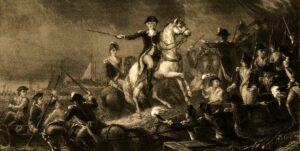
Among many historians, the most famous and successful night of the American Revolution was General George Washington’s crossing of the Delaware on Christmas Eve 1776. This bold and brilliant military plan achieved by cunning and courage is considered a crucial factor for the young American country winning its independence. However, earlier in that year, there was another night obscured from our patriotic memory that had a greater impact on the eventual victory. In modern parlance, we would call it a “successful failure” because Washington and his army wobbled on the brink of defeat before salvaging a remarkable reprieve.
In August 1776, the American Revolution came dangerously close to ending before it had begun. Only weeks after the Declaration of Independence had announced a new nation to the world, General George Washington found his army battered, cornered, and facing destruction on Brooklyn Heights. Across the East River lay Manhattan and the possibility of survival. Behind him stood one of the most powerful military forces on earth.
The episode is often remembered as a retreat, but that word hardly captures what happened. Washington’s escape from Brooklyn was not a simple withdrawal from a lost battlefield. It was a desperate act of discipline, secrecy, endurance, and judgment under pressure. It preserved the Continental Army at the very moment when losing it might have ended the Patriot cause.
New York mattered deeply in 1776. After the British evacuated Boston in March, Washington correctly expected that their next move would be against New York, whose harbor made it one of the most valuable strategic locations in North America. He moved his troops south and began preparing defense of Manhattan Island and across the river in Brooklyn. Washington and his army faced daunting odds, especially because his troops were inexperienced and under supplied. They were not yet operating as a trained professional force as compared to The British troops, under General William Howe which were trained and well-armed.
In August, Howe arrived in New York with over 32,000 men and a formidable fleet of fighting ships. Washington’s army numbered no more than 3,000 infantry. On August 27, the British struck. While some British and Hessian troops attacked American positions from the front, a larger force moved through the lightly guarded Jamaica Pass and came around the American flank. The result was a severe defeat. American units fought bravely, including the famed Maryland troops who helped delay the British advance near the Old Stone House, but courage could not erase the tactical disaster. By the end of the fighting, Washington and his men retreated to its fortifications on Brooklyn Heights with the East River at its rear.
For Washington, the danger was plain. If Howe ordered a direct assault or if the British fleet moved into position to block the river, the Americans might be trapped. Thousands could be killed or captured. The army that embodied the Revolution could cease to exist. Fortunately for the Americans, Howe chose caution rather than attack the fortified lines immediately. The British began siege preparations and that pause gave Washington the one thing he needed most: time.
Washington did not waste it. On August 29, after consulting his officers, he decided to evacuate the army across the East River to Manhattan. The plan had to remain secret. If the British discovered the movement too soon, the retreat could become a rout. Boats were gathered. Soldiers were told enough to move, but not enough to spread alarm. Units quietly began leaving their positions and making their way toward the ferry landing. A skeleton force remained behind to keep campfires burning and create the appearance that the army was still in place.
The crossing was exhausting and difficult due to poor weather. Sailboats and rowboats had to move men, horses, artillery, and supplies through darkness and confusion. Marblehead sailors from Massachusetts and other experienced watermen played a crucial role, making repeated crossings under immense pressure. Every hour mattered. Dawn would expose the operation, and with it the vulnerable Americans still waiting to cross.
As morning approached on August 30 and as if by divine providence, a dense fog settled over the river and the Brooklyn shore. It concealed the final stages of the evacuation long enough for the remaining troops to get away. When the British realized what had happened, Washington and his army were gone. The escape had succeeded.
Using historical hindsight, it is easy to conclude the retreat as inevitable because the Revolution eventually succeeded. At the time and circumstances, Washington knew that nothing about his actions were guaranteed. British power seemed overwhelming and had Washington suffered a major defeat, his army and the rest of the colonial population would have been demoralized. His decision at Brooklyn shows one of his strongest qualities as a leader: he understood that survival could be strategic. He did not need to win every battle. He needed to keep an army in the field, keep the cause alive, and wait for better opportunities.
This outcome served as a lesson that would define much of the war. The Revolution was not won by one dramatic victory but by endurance through reverses, shortages, mistakes, and narrow escapes. Washington’s strategic acumen did not exhibit brilliance, but dedication to persistence and restraint. At Brooklyn, he recognized danger without surrendering to panic. He accepted defeat without allowing it to become final. He chose withdrawal not as an admission that the cause was lost, but a way to preserve the possibility of future victory.
To we Americans today, the retreat from Brooklyn offers a powerful reminder that history often turns on moments of recovery. We love to celebrate our military victories and triumphs and think they were preordained; however, we often forget they were achieved by our response to setbacks and risk of failure. Washington’s army did not look victorious as it slipped across the East River in the dark. It looked tired, wet, frightened, and fortunate. Yet because it survived, the Revolution survived with it.
In the years that followed, Washington would face more defeats and disappointments before independence was secured. The Continental Army’s escape at Brooklyn stands as one of the clearest examples of his leadership under pressure. He did not save the Revolution by standing still for the sake of appearances. He saved it by knowing when to move, when to risk secrecy, when to trust his soldiers and sailors, and when to fight another day.
On that fog-covered morning in 1776, the British looked across Brooklyn Heights and found empty works where an army had been. Washington had turned disaster into survival. And in a struggle where survival was often the first condition of victory, that made all the difference.
Jeff Dalmer
Vacation Liberty School