
John Adams and Thomas Jefferson: A Friendship Shaped by Revolution and Rivalry
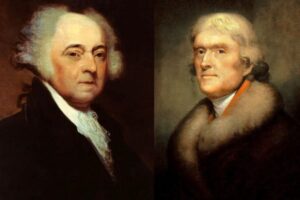
At first glance, John Adams and Thomas Jefferson seemed unlikely companions. Adams was fiery, talkative, and impatient with hesitation; Jefferson was quiet, polished, and more comfortable letting his pen speak for him. Yet these two very different men became central partners in the American founding. They stood together in the struggle for independence, drifted apart as politics hardened into rivalry, and then, in old age, found their way back to one another through letters filled with memory, reflection, and debate. Their relationship reads almost like a novel: a story of admiration, ambition, betrayal, and reconciliation played out alongside the birth of the United States itself.
Their story began in the Continental Congress, where both men arrived as defenders of the colonial cause. Adams quickly recognized something powerful in Jefferson. Though Jefferson was younger and less outspoken, he possessed a gift for language that Adams knew could move people. When the time came to draft the Declaration of Independence, Adams urged Jefferson to take the lead. It was a moment that revealed how well they complemented each other: Adams pushed, argued, and organized, while Jefferson shaped ideas into memorable prose. In the years that followed, they served abroad as diplomats and grew closer still. Jefferson’s friendship with Abigail Adams added warmth to the bond, and for a time it seemed that the two men—so different in style—had found in each other an enduring political and personal ally.
But the friendship that had formed in revolution was tested in peace. Once independence had been won, the urgent question became what kind of nation the United States would be. On that question, Adams and Jefferson increasingly diverged. Adams feared disorder and believed a stronger national government was necessary to preserve stability. Jefferson placed greater faith in local control and worried that centralized power could threaten liberty. As the 1790s unfolded, these disagreements hardened into party identity. Adams became linked with the Federalists, Jefferson with the Democratic-Republicans. What had once been a partnership of shared purpose slowly turned into a contest between competing visions of America, and personal affection began to give way to mistrust.
That mistrust reached its height in the election of 1800, a contest so fierce that it seemed to put the young republic itself on trial. By then, Adams was president and Jefferson his vice president, an awkward arrangement created by the original electoral system. The campaign that followed was brutal. Allies and newspapers on both sides traded accusations, and the bitterness of national politics cut directly into what remained of their friendship. Jefferson’s victory marked a peaceful transfer of power—one of the great achievements of the early republic—but it also left deep scars. Adams, stung by defeat, left Washington before Jefferson’s inauguration. Jefferson, in turn, viewed Adams’s final judicial appointments as a last attempt to preserve Federalist influence. The silence that followed between them lasted for years and seemed to confirm that their friendship had been lost for good.
And yet the story did not end there. In 1804, following the tragic death of Jefferson’s daughter, Mary (Polly) Eppes, Abigail wrote a heartfelt letter to Jefferson expressing her grief over the loss. Abigail and Polly became great friends during the time when both Jefferson and Adams were on diplomatic missions in France and England. Polly lived with Abigail while the men were away. Although the letter didn’t completely thaw the relationship it opened the door. 1812, encouraged in part by their mutual friend Benjamin Rush, Adams and Jefferson began writing to each other again. What followed was one of the most extraordinary correspondences in American history. Across fourteen years, they exchanged letters that revisited old battles and explored questions much larger than themselves: the fate of the republic, the meaning of the Revolution, religion, philosophy, and the experience of aging in a world they had helped change. Their letters could still carry flashes of disagreement, but the sharpness of partisan combat had softened into something richer—an old friendship rebuilt on honesty, memory, and mutual respect. In these later exchanges, Adams and Jefferson no longer appear simply as rivals. They appear as two aging revolutionaries trying to understand their own era and each other.
In the end, the relationship between John Adams and Thomas Jefferson mattered not only because of who they were, but because of what their story reveals about the nation they helped build. Their lives traced a dramatic arc from cooperation to rivalry to reconciliation, mirroring the struggles of the early United States as it tried to define freedom, authority, and political legitimacy. Even the final chapter of their story feels almost literary: both men died on July 4, 1826, the fiftieth anniversary of the Declaration of Independence. That coincidence has given their relationship a lasting symbolic power. But the real significance lies in the way their interactions illuminate the human side of history. Adams and Jefferson were not marble statues. They were proud, brilliant, flawed men whose friendship and conflict helped shape the American republic.
Jeannie Simpson
Vacation Liberty School