The 13 Colonies – A New Beginning
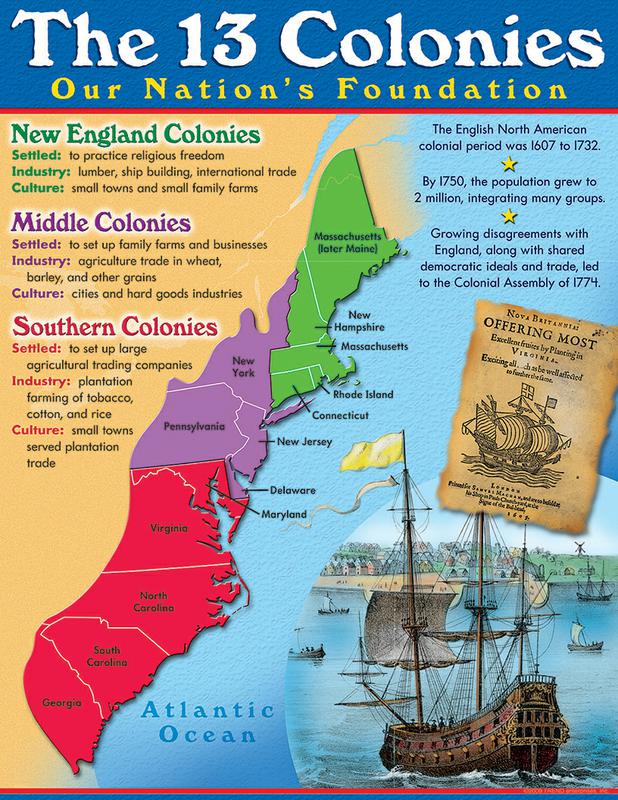
The English North American colonial period dates from 1607 to 1732. By 1750 the population of these colonies, sharing their proximity to the Atlantic Ocean, grew to 1.17 million people, integrating many communities with different ideas on how to navigate their circumstances.
The New England Colonies settled with the main purpose of practicing their religious freedom. Their industries primarily were lumber, ship building, and international trade that were based in small towns and on small family farms. This region included New Hampshire, Massachusetts (and later Maine), Rhode Island and Connecticut.
The Middle Colonies settled to set up family forums and new businesses. Their industry was primarily centered around agriculture of wheat, barley and other grains. They created cities and hard good industries. This set of colonies included New York, Pennsylvania, New Jersey and Delaware.
The Southern Colonies created large agricultural trading companies in the form of plantation farming of tobacco, cotton and rice in small towns servicing the plantation trade. This area included Virginia, North Carolina, South Carolina and Georgia.
The governments of the Thirteen Colonies of British America developed in the 17th and 18th centuries under the influence of the British constitution. The British monarch issued colonial charters that established either royal colonies, proprietary colonies, or corporate colonies. In every colony, a governor led the executive branch, and the legislative branch was divided into two houses: a governor’s council and a representative assembly. Men who met property qualifications elected the assembly. In royal colonies, the British government appointed the governor and the council. In proprietary colonies, the proprietors appointed the governor and his council. In corporate colonies, voters elected these officials.
In domestic matters, the colonies were largely self-governing on many issues; however, the British government did exercise veto power over colonial legislation, and regardless of the type of colonial government, retained control of the law and equity courts; judges were selected by the British government and served at the king’s pleasure. Diplomatic affairs were handled by the British government, as were trade policies and wars with foreign powers (wars with Native Americans were generally handled by colonial governments).
Growing disagreements with England, along with shared democratic ideals and trade, led to the Colonial Assembly of 1774. The First Continental Congress was a meeting of delegates of twelve of the Thirteen Colonies (Georgia did not attend) held from September 5 to October 26, 1774, at Carpenters’ Hall in Philadelphia at the beginning of the American Revolution. The meeting was organized by the delegates just after the British Navy implemented a blockade of Boston Harbor and the Parliament of Great Britain passed the punitive Intolerable Acts in response to the Boston Tea Party.
The American Revolution (1775–1783) was a dispute over the British Parliament’s right to enact domestic legislation for the American colonies. The British government’s position was that Parliament’s authority was unlimited, while the American position was that colonial legislatures were coequal with Parliament and outside of its jurisdiction. As the revolution progressed, the colonial governments were replaced by temporary provincial congresses and ultimately by state constitutions establishing republican governments. The colonial experience informed and shaped the new state constitutions and, ultimately, the United States Constitution adopted in 1789.
*Courtesy of Wikipedia and Poster Courtesy of Empower Your Knowledge
https://empoweryourknowledgeandhappytrivia.wordpress.com/2014/12/01/thirteen-colonies/