
Celebrating Flag Day June 14, 2023 aka Old Glory, Star-Spangled Banner, Stars and Stripes
“During the night of September 13, 1814, the British fleet bombarded Fort McHenry in the harbor at Baltimore, Maryland. Francis Scott Key, a 34-year-old lawyer-poet, watched the attack from the deck of a British prisoner-exchange ship. He had gone to seek the release of a friend, but they were refused permission to go ashore until after the attack had been made. As the battle ceased on the following morning, Key turned his telescope to the fort and saw that the American flag was still waving. The sight so inspired him that he pulled a letter from his pocket and began to write the poem, which eventually was adopted as the national anthem of the United States—“The Star Spangled Banner.” Key was returned to Baltimore and later that day took a room at a Baltimore tavern where he completed the poem.
Years later, Key told a hometown audience in Frederick Maryland: “I saw the flag of my country waving over a city —the strength and pride of my native State — a city devoted to plunder and desolation of its assailants. I witnessed the preparation for its assaults. I saw the array of its enemies as they advanced to the attack. I hear the sound of the battle; the noise of the conflict fell upon my listening ear, and told e that “the brave and the free’ had met the invaders.”
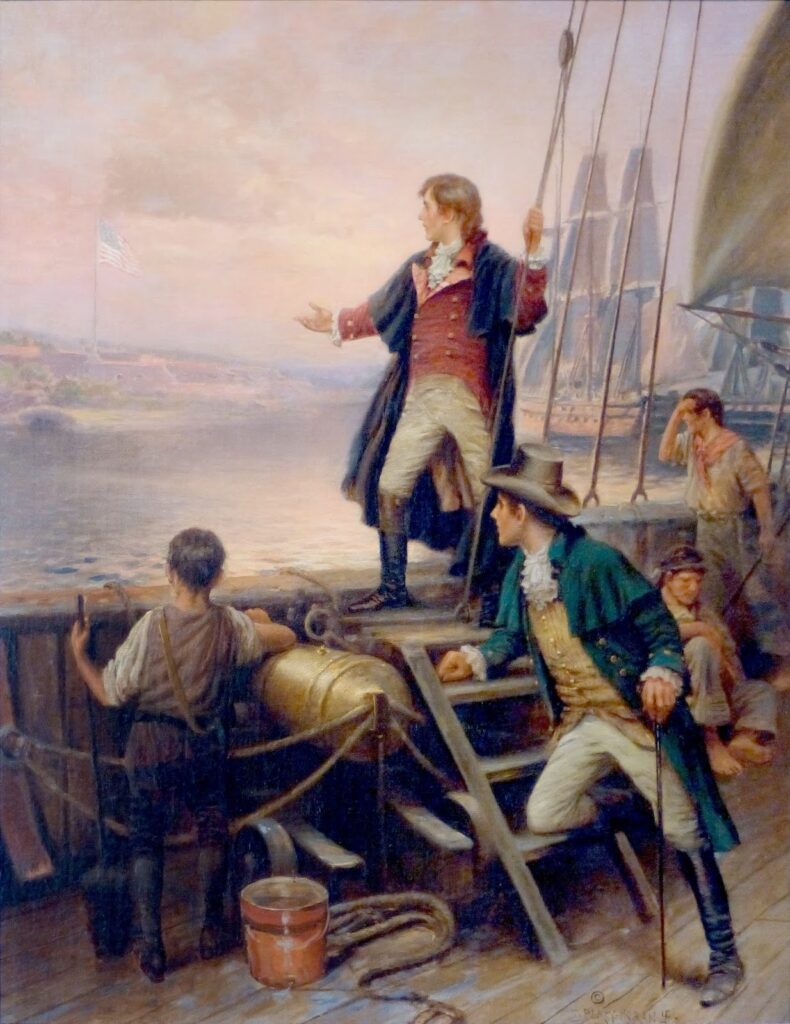 “By the Dawn’s Early Light” (ca. 1912) by Edward Percy Moran hangs in the Star Spangled Banner Flag House Museum in Baltimore Maryland. Courtesy of http://foundingfathers.info/American-flag/Star-Spangled-Banner.html
What is flag day?
When the American Revolution broke out in 1775, the colonists weren’t fighting united under a single flag. Instead, most regiments participating in the war for independence against the British fought under their own flags. In June of 1775, the Second Continental Congress met in Philadelphia to create the Continental Army—a unified colonial fighting force—with the hopes of a more organized battle against its colonial oppressors. This led to the creation of what was, essentially, the first “American” flag, the Continental Colors.
For some, this flag, which was comprised of 13 red and white alternating stripes and a Union Jack in the corner, was too similar to that of the British.
George Washington soon realized that flying a flag that was even remotely close to the British flag was not a great confidence-builder for the revolutionary effort, so he turned his efforts toward creating a new symbol of freedom for the soon-to-be fledgling nation.
On June 14, 1777, the Second Continental Congress took a break from writing the Articles of Confederation and passed a resolution stating that “the flag of the United States be 13 stripes, alternate red and white,” and that “the union be 13 stars, white in a blue field, representing a new constellation.”
Over 100 years later, in 1916, President Woodrow Wilson marked the anniversary of that decree by officially establishing June 14 as Flag Day.
Courtesy of https://www.history.com/news/what-is-flag-day