
Currier and Ives’ America

After discovering the book Currier & Ives’ America, which features over 80 lithographs of America during the early 19th century, we felt the images and comments by editor Colin Simkin might give our readers a glimpse into what life was like in early America. Therefore, we will be featuring several of the lithographs and text from the book over the coming year. Please note we are not reproducing the book verbatim, but rather selecting specific text and images to adequately portray the subject matter. Published in 1952, the book is now out of print, but can be purchased on Ebay, if you are interested. We want to thank Crown Publishing: New York and Scott Currier of Currier & Ives for making this possible.
The Beginnings
Currier and Ives prints were produced by the method known as lithography. The technique was the accidental discovery of a young Bavarian named Alois Senefelder, son of a performer in the theatre at Munich. As he tells it in his autobiography, his mother asked him to jot down a list of items. Finding his writing ink dried up, he picked up a piece of the caked ink and scribbled on a convenient tile. When he went to wash off the stone later, he was struck with the fact that the porous stone absorbed water everywhere except where the ink had been applied. Thus in 1796 was established the basic principle of lithography, which is that water and grease do not have affinity for each other.
Reduced to its simplest terms, the process consists of applying lettering or drawing to a prepared stone by means of a greasy ink or crayon. The stone is moistened with water, which it absorbs wherever there is no drawing. By means of a roller, a greasy ink is applied to the stone which retains it only where the design appears; the moistened part of the stone does not become inked. A piece of paper is pulled off, the ink has transferred to the paper. The impression on the paper faces the opposite direction to that on the stone, which is why the lithograph artists who drew on the stone had to letter or draw in reverse of what the finished product was intended to be.
The lithographic process with its speed, economy and ease of making reproductions had a pronounced effect on the printing business, an influence which has survived to this day.
In 1826, thirty years after Senefelder’s discovery William Pendleton imported some of the materials and equipment and set up in Boston on of the first lithographic firms in this country. It was to William and John Pendleton that Nathaniel Currier, then a boy of thirteen, was apprenticed. In 1829 John Pendleton formed a new partnership in Philadelphia and took Currier with him. Several years later Pendleton opened another shop in New York City, again taking with him young Currier, who had not quite completed his apprenticeship. In 1834, having finished his training, Nathaniel Currier felt qualified, as indeed he was, to go into business. By 1835, then twenty-two years of age, he had his own establishment. Up to that time the lithographic business consisted chiefly of printing letterhead, commercial forms, music, maps and other items involving lettering an a limited amount of design.Although some other lithographers may have experiments with the reproduction of portraits or other art work, it is generally conceded that it was Currier who first saw the possibilities of publishing newsworthy subjects.
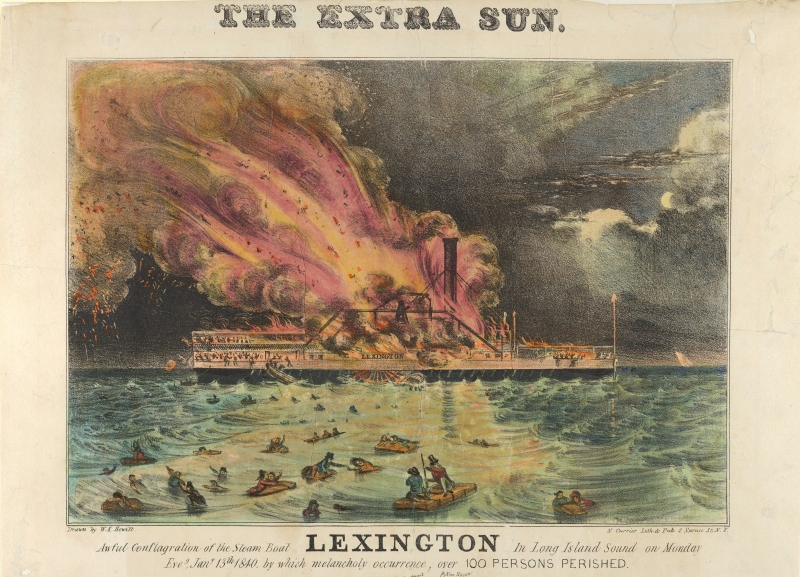
Currier & Ives “The Awful Conflagration of the Steam Boat Lexington in Long Island Sound, on Monday Eve’g Jan. 13th, 1840”, Courtesy of THE MET
The next milestone and perhaps the most important one in the Currier’s career was a catastrophe – the “Awful Conflagration of the Steam Boat Lexington in Long Island Sound, on Monday Eve’g Jan. 13th, 1840, by which melancholy occurrence over 100 persons perished.” The Lexington, embodying all the latest improvements in such craft, had been given considerable publicity. The misfortune which overtook it was a shock comparable to the later loss of the Titanic or the Lusitania. Being winter, it was probably two or three days before the news of the disaster reached New York City. The Sun commission Currier to lithograph a view of the burning steamboat. A sketch was drawn by W. K. Hewitt, based on the reports of how rapidly flames enveloped the boat, of the inept launching of the lifeboats and of the passengers making the awful choice between death by fire or drowning in the icy waters. The Extra Sun hit the streets before the event was a week old. The demand for this sensational printed was tremendous. Currier’s press ran day and night. Copies were sold in nearly every city in the country. Editorial comment hailed a new era of pictorial reporting. Currier had achieved national recognition and learned a valuable lesson.
The Thriving
Currier’s business began to grow at a phenomenal rate. Among the additional help which he employed was a man named James Merritt Ives. Ives at first was a bookkeeper and general handyman, but his talent and abilities become so indispensable to Currier that within a few years he was made partner. In 1857 and thereafter, all the publications of the firm carried the joint imprint of Currier & Ives.
Currier and Ives prints include such a wide variety of subjects that practically every phase of life in America of that period is covered. As if conscious of their destiny as recorders of the mid-nineteenth century scene, they almost invariably showed people doing things, great changes that were taking place. In one notable case the firm anticipated the news. A print showing the first transcontinental train, “Across the Continent,” was copyrighted and published in 1868; the last spike was not driven until 1869.
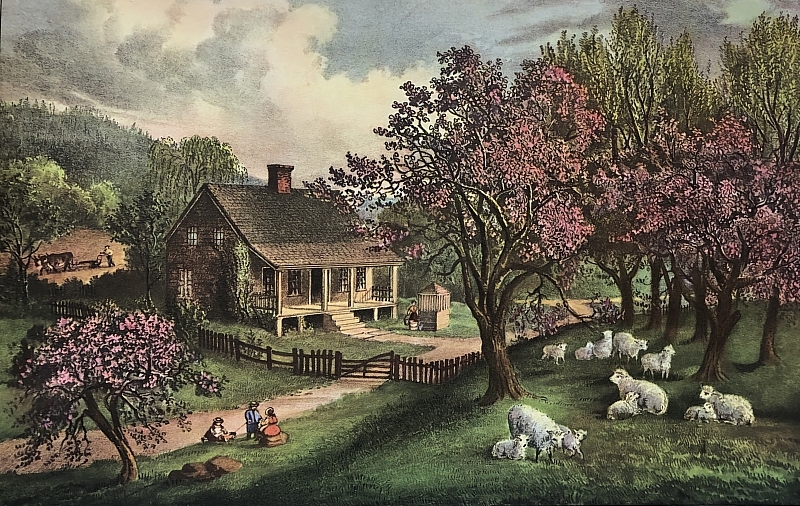 American Homestead “Spring”- One of the lithographs featured in Currier and Ives’ America: A Panorama of the Mid-Nineteenth Century Scenes, Courtesy of Crown Publishers, Inc. : New York
The home which Currier & Ives chose as the typical American dwelling was in a rural setting. It would have been earlier, and certainly understandable, if they had used as the model a house in the city or of the mansions along the Hudson River shores with which they were familiar. Quite properly they selected a rather squarish frame building of the type still to be seen throughout New England. Constructed with native materials, chiefly lumber from a nearby sawmill, its lines showed little influence of European architecture. It was probably built without benefit of any architect’s plans. But it was neat and sturdy and had little waste space in it – even the stairs were compressed into a steep and narrow flight. It was surrounded by the fields and pastures and orchards which were the owner’s chief means of livelihood. The house usually on a slight rise, was conveniently near the road.
Dormer windows, and porches which they seldom had time to enjoy, were the added afterthought of a later generation. This is evident in several prints, particularly noticeable in the illustration “Spring/” In recent years city folks have been seeking and acquiring these New England farms for summer use. One of the first steps in restoring the house is to tear off the obtrusive appendage and reveal once again the dignified and conservative lines of the American homestead.
Proof of the firm’s good judgement in selecting these subjects was the tremendous popularity of this set. Many thousands must have been produced. In spite of the hazards of more than eighty years, enough of them remain so that, notwithstanding its popularity today, it is neither difficult or costly to assemble a complete set.
It is to be noted that “Summer” and “Winter” were copyrighted in 1868, whereas “Spring” and “Autumn” bear the date 1869. This would seem to indicate that originally there was only the pair, and that its salability led the print-makers to expand the set to four subjects.
Courtesy of Crown Publishing New York and Scott Currier of Currier & Ives, featuring selected text from Currier & Ives America.