The Winter Patriots: A Revolutionary War Tale
A Conquering Wind…
For more than a year 13 colonies stood in rebellion to their government an ocean away. The Americans in revolt were rebels, the Declaration of Independence made them revolutionaries. Thirteen colonies were now a union of states, then in union they claimed independence, disseminating copies of their great declaration in the land. In New York City the Declaration was read allowed to an army of volunteers on that day July 9th in 1776 they at last knew what they were fighting for; a new nation conceived in liberty. This army was made up of farmers and tradesmen and artisans from every walk of life. Their officers were businessmen, lawyers and planners …mostly amateurs. Even their commander in chief, the most experienced among them, never led more than one thousand men in combat. Now General George Washington led more than 23,000.
Independence, however grandly declared, would not be won by words and while Americans cheered, the British army, 25,000 strong, more than half of the armed forces of the British Empire, descended upon New York to contest the argument. British soldiers under General William Howell were well-trained, well-equipped and well-paid and their ranks were bolstered by German contract soldiers, these Hessian’s famous for their skill and feared for their fierce fighting ability made up over a third of the army. In short order they swept Washington’s army in battle after battle over Brooklyn, New York, Manhattan, White Plains, the Jersey palisades, leaving little to stop them from seizing Philadelphia the seat of the fledgling nation. With mounting defeats joy was replaced by desperation. Many of Washington’s soldiers deserted for home as they retreated south. By only 3,800 soldiers were left. Washington despaired of what the future might bring writing, “I am weary almost to death.”
British General Howell was convinced Washington and the American army had lost the will to fight. It was hard to disagree. New York City had fallen and the British occupation had spread to control three colonies. The Continental Army was badly beaten, outflanked, demoralized. The rebellion seemed doomed. Washington’s army, the Americans, the United States needed a miracle.
The American Crisis
As the British and Hessian soldiers occupied New Jersey they behaved like conquerors, ravaging homes, stealing property, not bothering to distinguish between patriots or loyalists. But Americans would not be idle victims. Incensed by the degradations, bands of New Jersey militiamen began to raid and attack small isolated British units and Thomas Paine the author of Common Sense, the popular voice of the American Revolution, while marching south with Washington’s army captured the desperate hopes of the moment, “These are the times that try men’s souls,’ he wrote. “The summer soldier and the sunshine patriot will in this crises shrink from the service of their country, but he that stands by now deserves the love and thanks of man and woman. Tyranny like hell is not easily conquered, but the harder the conflict the more glorious the triumph.”
Paine’s words spread like wildfire amongst the Patriots that winter. His American Crisis essays were read in taverns, churches, courthouses, state houses, and on the banks of the Delaware, in the tents and around the campfires of Washington’s army. Stoked by the harsh British occupation and inspired by Paine’s stirring call to duty Washington’s army had begun to grow again. By mid-December over 7000 were prepared to defend the cause, a cause the British considered already dead!
Aided by spies in the field Washington realized that while the British had more soldiers, they were thinly scattered along outposts and towns throughout New Jersey. And one of the most important outpost, Trenton, isolated by poor roads was especially vulnerable. If Washington could cross the Delaware quickly he could strike the Trenton outposts before enemy reinforcements might arrive. All would depend on stealth and speed. But, how could he quickly cross the Delaware River, a task that had recently taken a smaller army five days and time was not on Washington’s side. By late December most of his soldier’s enlistments would end. His army would disappear. “By perseverance and fortitude we have the prospect of a glorious issue,” wrote Paine, “but by cowardice and submission, sad choice, is a ravaged country and slavery without hope.” If salvation as Paine pointed out, salvation were at hand, Washington would be tested with a very bold move.
Washington’s Crossing
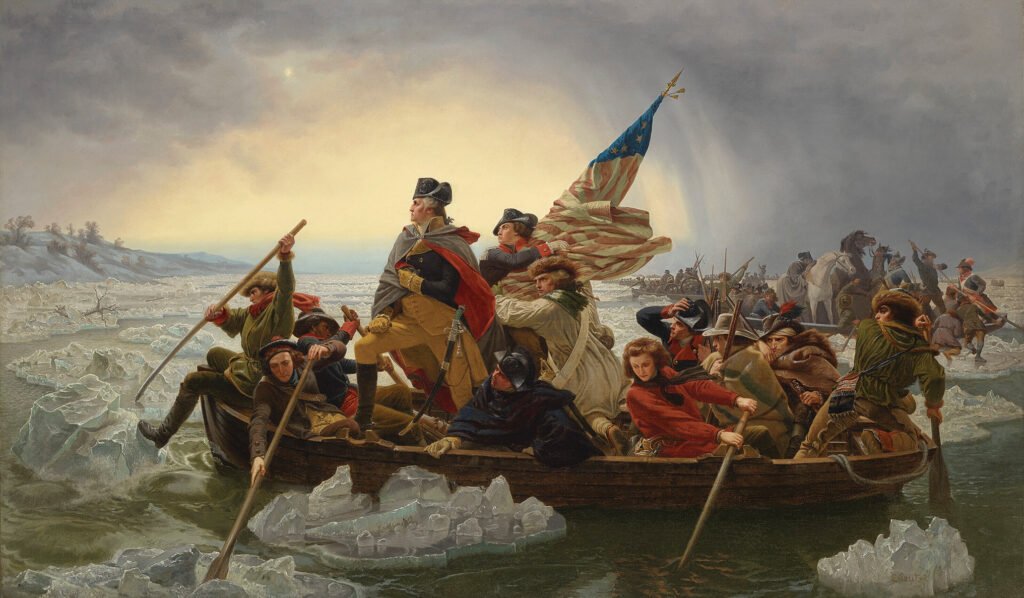
Washington’s plan is risky. On Christmas night in the dead of winter his army would cross the Delaware River at three points and trap the Hessian’s between them. Washington with 2,400 soldiers and much of the artillery would march to Trenton for the main attack. James Ewing’s Brigade of 800 Pennsylvania militiamen would seize the bridges across Assunpink Creek and Col. John Cadwalader 1,200 Philadelphia associate-rs and 600 continentals would distract the Hessian grenadier’s and Scottish Highlanders stationed at Burlington. But this grand design began to unravel almost as soon as it started. Huge chunks of ice made the Delaware are almost impassable. Ewing’s troops at Trenton Ferry and Cadwalader’s force further south, both failed to cross the river.
Washington’s main strike force fared little better moving slowly as the light rain gave way to driving hail and snow. 2400 men as well as forces and eighteen pieces of fuel artillery, each gun weighing around 2000 pounds, needed to be ferried across the icy river. Washington himself crossed first to watch the rest of his army struggle to follow, but they all finally reached the New Jersey side of the river at 3 AM. They were a full three hours behind his carefully choreographed plan.
Washington brooded over the delay. With his entire army at risk should he turn back? “As I was certain there was no making a retreat without being discovered and harassed on re-passing the river, I determined to push on at all events,” – Washington. With the icy river behind them, turning back was not an option.
The Attack (night of December 25–26, 1776)
Despite the delays Washington and his generals decided to follow the original plan. Washington’s column approaches Trenton in two waves. Defending Trenton were three battle hardened Hessian regiments. 1,500 men under the command of Col. Johann Gottlieb Rhall. Contrary to legend they were not drunk or even drinking. Instead they were on high alert. Hessian pickets guard the approaches to Trenton. Those not on duty sleep in battle dress, loaded muskets within reach. Despite the preparation, Raul’s men are caught by surprise, erroneously believing Washington has the town encircled, but considering the American’s poor soldiers Raul orders his men to counter attack. Knox’s field guns and American musket fire shattered their every approach.
Rallying his men for one last frontal assault Raul is shot twice in the side. He’ll die later that night.
When the remaining Hessian’s attempt to retreat their only route of escape is cut off by General Sullivan’s arriving column. Though some Hessian’s make it out, Washington’s men capture almost 900 and inflict 100 casualties. As the captured arms equipment cannon and gun powder is tallied, Washington is forced to confront his own losses. Despite suffering many wounded and others incapacitated by the severe weather, he reports on several killed, men who froze to death in the unforgiving cold. But, more valuable than guns or ammunition was the victory itself. Though his attack was behind schedule, his conditions fought with rain, snow, sleet and his enemy was at the ready, General Washington had shocked the greatest empire of the day.
A British officer foresaw the implications writing of Trenton, “I was exceedingly concerned as it will tend to revive the drooping spirits of the rebels and increase their force.”
A Second Crossing
There was little time to rest or celebrate. Laden with captured supplies Washington’s army slipped across the river back into Pennsylvania. He knew that a single victory was not enough, plus time was running out. The soldiers enlistments ended in a matter of days. On December 27, just a day after capturing Trenton, Washington learned that Col. Cadwalander’s 1,800 Pennsylvanian’s had crossed into New Jersey, probing the British defenses. There reports indicated the British were panicking and falling back. Was this the moment to strike another blow?
Washington asked for an honest assessment from his advisors. At first some argued that a second crossing would tempt fate, others pressed for action. As they debated into the night the consensus began to shift, as more realized without another victory Trenton could be dismissed as a lucky blow. Soon they all agreed, they would move immediately. Once again the weather doesn’t cooperate. If the first crossing was bad, the second was worse. Yet, by New Year’s Eve most of the army is across the river, back in Trenton. New Year’s Eve was also the day that many of his soldiers’ enlistment ended. Some were leaving for home, others could not be compelled to stay and if they left his army would collapse.
Washington appeals to his men’s patriotism. “You have done all I asked you to do and more, but your country is at stake. Your wives, your houses, and all that you hold dear. You have worn yourselves out, but we know not how to spare you. If you will stay one more month longer, you will render that service to the cause of liberty and to your country under, which you would probably never do under any other circumstances.” His words were bolstered by $10 in hard coin for every man who stepped forward. It worked! His army remained, soon to fight again.
The Battle of the Second Trenton
6,800 Americans ushered in the New Year of 1777 east of Trenton along Assunpink Creek, New Jersey. The British had pulled back to Princeton, 11 miles away. Lord Charles Cornwallis who had chased Washington’s army across the New Jersey countryside moved to confront Washington with over 8,000 troops, including a body of Hessian’s intent on revenge.
Washington intended to meet them on good ground. Yet, with the Delaware River at his back there was no easy way to escape, if the British forced a retreat. To buy time Washington orders 1,000 men to harass Cornwallis’s force as they approach from the North. The delaying force falls back across a stone bridge over Assunpink Creek. As British musket balls whistle by Washington rode to the bridge to greet them, inspiring confidence and assurance to his men.
Assured of his army’s superiority Cornwallis orders three successive and bloody assaults across the narrow bridges and lower fords. In the face of blistering American cannon and musket fire all British attempts fail as the light disappears. For his rash assault Cornwallis lost 365 men, for the Americans who continued to hold their defensive line along the creek, the losses were 100. For the second time in two weeks Washington and his rag-tag army had proven their metal against some of the best combat troops in the world.
A Tale of Two Councils
Despite his losses Cornwallis is convinced he has Washington cornered and resolves to finish him off at dawn. But, one of his subordinates, Sir William Erskin warns, “If Washington is the General I take him to be, he will not be found in the morning.” Discovering that a northern ford provides access to Washington’s vulnerable right flank Erskin advises an immediate attack across the Assunpink. Washington lays out the stakes to his officers. A loss of this army might be fatal to the country, but a retreat would also have a lasting negative consequences.
They were in a double bind. American Brigadier General Arthur Sinclair proposes a novel solution. The roads northward appeared open, the army could move out of danger, outflank Cornwallis and take Princeton. Despite some naysayers, all soon agreed it was a daring option. They could escape the danger of Cornwallis’s larger army. And, ever aware of public opinion Washington was sure of one thing, this move would at least avoid the appearance of a retreat.
With the support of his officers Washington approved the plan. But, would they have time to move before Cornwallis attacks and could they slip away without detection. The bright fires the American camp, visible well into the early morning, showed that Washington’s men were settled in. General Cornwallis remained confident, saying “We have the old fox safe now. We’ll go over and bag him in the morning.” But, the American camp fires were a ruse, left behind to cover Washington’s move. At dawn Cornwallis was shocked to discover his opponent had slipped away. The fox had just executed one of the most brilliant flanking maneuvers in military history.
The Battle of Princeton
Washington marched his army in two columns throughout the night to Princeton. As the Americans approach Col. Charles Mawhood moving south to reinforce Cornwallis with 450 grenadiers, Scottish highlanders and workers, spots Nathaniel Green’s force assessing the situation quickly, Mawhood immediately attacks across a rising field. The battle begins on Clark Farm. After a vicious, bloody firefight, Mawhood orders bayonets fixed and breaks an American brigade led by General Hugh Mercer. Thinking they have cornered the chief rebel himself, General Washington, the British surround, taunt, bayonet Mercer, leaving him dead. The arrival of a force of Cadwallader staves off defeat, aided by a pair of four pound cannons they slow the British onslaught. Even these efforts prove insufficient and Cadwallader’s men soon begin to give way. At this moment Washington himself arrives on the spot, again exposing himself to musket fire. Rallying his men with a cry, “Parade with us my brave fellows.” Leading his advance they force the British to break and run. Galloping after the broken remnants, Washington shouts, “It is a fine fox chase my boys.” Mawhood and his garrison ultimately flee Princeton, leaving it to the Americans. British were retreating. In just a matter of weeks Washington and his army shattered the illusion of British invincibility.
A Revolution Saved
Washington had won at Trenton twice and drove the British from Princeton. Now he contemplates yet another roll of the dice. Brunswick holds a tantalizing cash of stockpiles and few British defenders, but with little sleep in the past two days his troops are beyond exhaustion. So, on January 7 Washington and the remainder of his victorious army head towards the mountain retreat at Morristown, New Jersey. From here his army supports the local militia, harassing the British and raiding the countryside, eliminating their supply routes and sources of food.
Like a thousand wasp stings the raids ultimately force the British to the relative safety and comfort of New York City. With his army now safely positioned around Morristown, Washington was forced to confront an even deadlier enemy, disease. His battle worn citizen soldiers huddled in winter encampments were prime targets for the great killer of the revolution, Small Pox. Fearing discovery through British agents, Washington boldly orders that his entire army be quietly inoculated. This action mandated in all Continental Army camps would save countless lives, lives of the very soldiers to continue the fight of freedom.
Facing what seemed to most on both sides as certain defeat, a rag-tag force of Continentals had stunned the British and the world. Washington’s bold stroke across the Delaware led to the defeat of three different Hessian and British forces in one brilliant campaign. The once mighty British army numbering 31,000 in the summer of 1776 had now been reduced to less than half that number and its great gains of territory had been largely wiped away in New Jersey.
Frederick the Great, King of Prussia, and one of the world’s great military might’s called Washington’s exploits those 10 fateful days the most brilliant of any recorded in the annals of military achievement. At the center of this great strategic reversal stood General George Washington, undaunted by the staggering losses of the summer of 1776 he provided the critical leadership that saved the remnants of the Continental Army and compelled them to victory at Trenton and Princeton. His strength tempered by flexibility and an open ear built an army able to absorb defeat, win victory’s and able to turn the dream of a new nation into a lasting reality.
Courtesy of Mount Vernon https://www.mountvernon.org/
YouTube – The Winter Patriots: A Revolutionary War Tale (Full Movie)
https://www.youtube.com/watch?v=CbGodj0lJ2Q